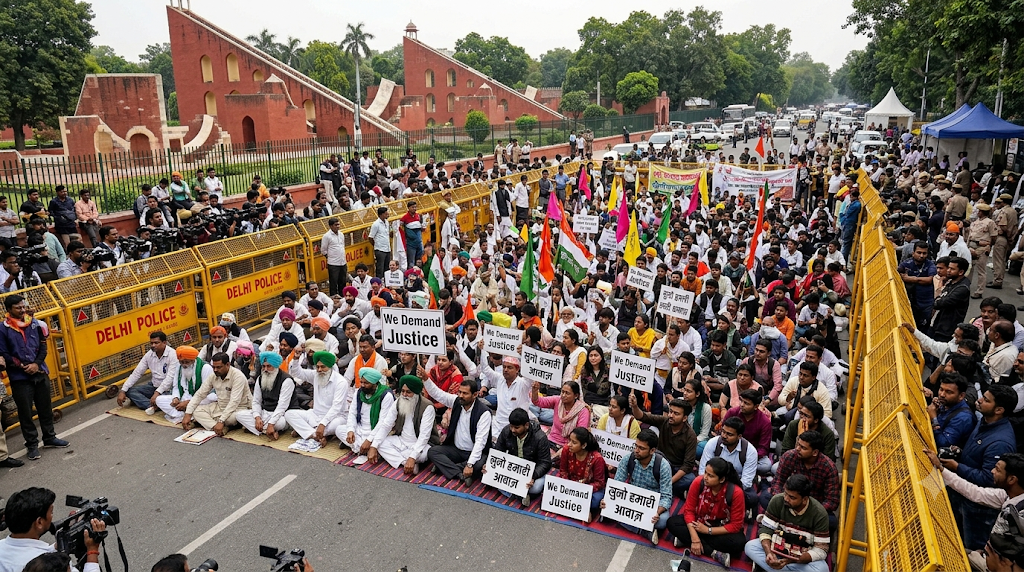

For more than three centuries, the terracotta structures of Jantar Mantar in New Delhi have tracked the movements of celestial bodies. Yet over the last three decades, this stretch along Sansad Marg has measured something entirely terrestrial: the pulse of Indian public sentiment.
Understanding Jantar Mantar’s role as India’s premier protest hub requires exploring why physical public squares remain indispensable in an increasingly digital world.
1. From Astronomical Wonder to Public Forum
Built in 1724 by Maharaja Jai Singh II of Jaipur, the Jantar Mantar was originally designed for astronomical calculations, featuring colossal masonry instruments that measured time and tracked the stars.
Its transition into a civic landmark began in 1993. Following the restriction of massive demonstrations at the Boat Club near India Gate due to security, administrative, and traffic disruptions, the authorities designated the stretch of Sansad Marg bordering Jantar Mantar as the official assembly point for protests and demonstrations in the national capital. This shift turned a scientific monument into an enduring symbol of democratic assembly.
2. Strategic Geography: Proximity to Power
Jantar Mantar’s enduring relevance stems from its strategic location, placing it at the very heart of the nation’s decision-making apparatus:
- The Legislative Axis: Situated barely a kilometer from Parliament House (Sansad Bhavan) and key ministries, the site puts demonstrators within physical earshot of the government.
- Media Proximity: The area’s central location on Sansad Marg makes it highly accessible for national and international press, ensuring immediate coverage of grassroots concerns.
- Containment & Safety: Framed by wide pavements and designated barricade lanes, the area allows law enforcement to manage and protect gatherings while ensuring the city’s essential daily transit continues around them.
3. Seminal Movements Hosted at Sansad Marg
Over the decades, Jantar Mantar has hosted demonstrations across every tier of civil society, serving as the launching pad for historic national debates:
- The 2011 Anti-Corruption Movement: Catalyzed by Anna Hazare, this movement transformed Jantar Mantar into the epicenter of a massive, nationwide call for systemic accountability.
- The 2012 Justice Movements: Spurred by a demand for greater safety and legal reforms, widespread citizen vigils here captured global attention and drove significant legislative shifts.
- Agricultural & Labor Delegations: Over the years, long-term sit-ins by regional farmer unions and trade organizations have consistently used this pavement to lobby for labor and economic protections.
4. The Legal Precedent: The Right to Assembly
The site’s status was heavily tested in 2017 when environmental and noise complaints prompted a temporary prohibition on protests at the site.
However, in 2018, the Supreme Court of India reaffirmed that peaceful demonstration is a constitutional guarantee under Article 19(1)(b). The court mandated clear regulatory guidelines rather than outright bans, enshrining Jantar Mantar as a permanent, legally protected venue for lawful assembly.
Final Thoughts
While digital activism and social media campaigns amplify slogans across borders, the physical presence of citizens outside the halls of power remains the most powerful instrument for accountability. Jantar Mantar is not merely a historic site; it is living proof of civic engagement in action.